Get Ready For Free NextGen TV Broadcasts With These 2022 Televisions
Get ready for free nextgen tv broadcasts with these 2022 world get ready for free nextgen tv broadcasts with these 2022 nfl get ready for free nextgen tv for sale get ready for ielts collins pdf free get ready for ielts reading collins pdf free let s get ready to rumble people get ready lyrics
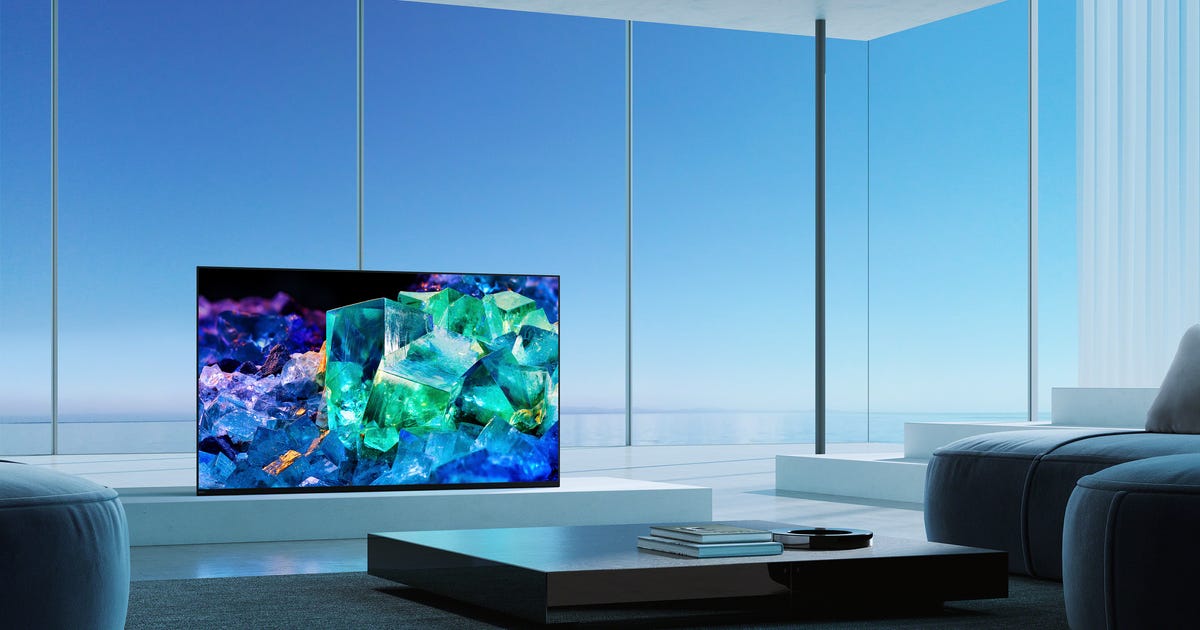
Get ready for free NextGen TV broadcasts with these 2022 televisions
The next version of broadcast TV, called NextGen TV or ATSC 3.0, is rolling out across the US, and will reach an estimated 75% of households by mid-2022. Upgrades over current antenna TV potentially include 4K resolution, enhanced sound quality and the web-like ability to interact with broadcasters via your television set. Unlike cable or streaming services, you can watch these broadcast channels for free, over the air with a standard antenna. You can find a list of available ATSC 3.0 areas here, and the number is growing by roughly two markets every month.
The signals are out there, but you also need something to watch them with. Most current TVs won't work with the new broadcasts. The ATSC says that 3 million compatible TVs were sold last year, and the organization estimates that 4.5 million will sell in 2022, but as you can see from the list below, most are high-end models.
LG, Sony and Samsung have produced compatible TVs in 2020 and 2021, and at CES 2022, Hisense was announced as the fourth official manufacturer. The biggest holdout is TCL, whose spokesperson said, "TCL TVs in the US use ATSC 1.0 tuners."
Meanwhile, a couple more companies also sell external tuner boxes, which work out cheaper than a whole new television. Manufacturers are also thinking beyond TVs as well, as there are future plans for including the technology in places such as cars.
Here's a list of 2022 TVs we know about that will feature ATSC 3.0 tuners.
Hisense

The newest manufacturer to add ATSC 3.0 tuners to its TVs, Hisense extends the feature down to the relatively affordable U7 series, which starts at $800.
- U9 : 76-inch
- U8 : 55-, 65- and 75-inch
- U7 : 55-, 65-, 75- and 85-inch
LG

The 2022 LG G2, seen here on an optional stand, has a thin "gallery" design and a brighter evo panel.
Richard Peterson/CNETLike last year, LG is restricting ATSC 3.0 support only to its most expensive OLED TVs. LG hasn't announced pricing, but the 2021 version of the G2 series, the G1, starts at $1,700 for a 55-inch size.
- G2 : 55-, 65-, 77-, 83- and 97-inch 4K OLED television
- Z2: 77- and 88-inch 8K OLED television
Sony

Sony is the only manufacturer to include ATSC 3.0 support across its entire range so far, and the initiative is now in its second year. As with most TVs on this list, pricing hasn't been announced, but the 43-inch model in the X80K series should cost around $500, if the 2021 version is any indication.
- Z9K : Mini-LED 75- and 85-inch 8K
- A95K: QD-OLED 55- and 65-inch 4K
- A90K: OLED 48, 42-inch 4K
- A80K: OLED 55, 65, 77-inch 4K
- X95K: Mini-LED 65-, 75-, 85-inch 4K
- X90K: Full-array LED 55-, 65-, 75-, 85-inch 4K
- X85K: Direct LED 43-, 50-, 55-, 65-, 75-, 85-inch 4K
- X80K: Direct LED 43-, 50-, 55-, 65-, 75-, 85-inch 4K
Samsung

So far Samsung has only released general information on its 2022 range, not specific models. TechHive reported that the company's Neo QLED line will be coming with ATSC 3.0 tuners, but a Samsung spokesperson told CNET that details were yet to be revealed. "We haven't announced specific number of models just yet, but I can say that our TVs ranging in size from 43-inch to 98-inch will support ATSC 3.0," they said.
Skyworth
China-based Skyworth has a limited presence in the US market so far, but did announce one TV that will have an ATSC 3.0 tuner.
- UD8500: 65- and 75-inch 4K UHD Mini-LED QLED with a bezel-less design
ATSC 3.0 DVRs, starting at $200

The Tablo ATSC 3.0 Quad HDMI DVR.
NuvvyoIf you want to watch next-gen TV broadcasts another option is to get an external tuner, which can connect to any TV. Currently they're rare, although a couple OTA DVRs do exist.
In April last year, SiliconDust released the $199 HDHomeRun 4K Flex, which is a DVR with four tuners, two of which are ATSC 3.0. It's a networked device, similar to the Amazon Fire TV Recast, that connects to streaming devices on the network and the internet via the HDHomeRun app.
The only ATSC 3.0 DVR announced for 2022 so far has been the Tablo ATSC 3.0 Quad HDMI. It's coming this spring for $299 and unlike the HDHomeRun it offers four full ATSC 3.0 tuners. The downside is that it's not networkable and so it's restricted to one TV.
At CES, the ATSC organization announced that a low-cost chipset from Mediatek would be available to put into cheaper devices, which could help prices on external tuners come down in the future.
NextGen TV outlook for 2022
There are two main issues with ATSC 3.0 in the US. The first is the lack of coverage in some of the country's biggest TV markets, including San Francisco, Chicago and New York City. The second is a lack of content. While the format promises 4K resolution and features like interactive gambling, these are largely yet to be implemented. Because the service is still maturing and depends on support from broadcasters, most areas still receive only 1080p signals. With budget-friendly devices and more coverage areas on their way, we may find that over the next few years ATSC 3.0 could finally live up to its cord-cutting potential.
§
NextGen TV, aka ATSC 3.0, is continuing its rapid rollout across the country. Major markets like Los Angeles, Atlanta, Denver, Houston and more all have stations transmitting. Meanwhile New York, Boston, and many other markets are slated to have broadcasts later this year. While not every station in every market has a NextGen TV counterpart, more and more are coming on the air.
What's NextGen TV? It's an update to the free HDTV you can already get over-the-air in nearly every city in the US. There's no monthly fee, but you do need either a new TV with a built-in tuner or a standalone external tuner. The standard allows broadcast stations to send higher quality signals than ever before with features like 4K, HDR, 120 Hz, and more. ATSC 3.0 proponents also claim better reception indoors and on-the-go -- whether it's on your phone, or even in your car. The best part is that if you're watching it on your TV it uses the same standard antennas available today.
One potential downside? ATSC 3.0 will also let broadcasters track your viewing habits, information that can be used for targeted advertising, just like companies such as Facebook and Google use today.
Read more: Best TV antennas for cord cutters, starting at just $10
NextGen TV to you
Here's the top-line info:
- If you get your TV from streaming, cable or satellite, NextGen TV/ATSC 3.0 won't affect you at all.
- The transition is voluntary. Stations don't have to switch. Many have already, however, for reasons we'll explain below.
- It's not backwards-compatible with the current HD standard (ATSC 1.0), so your current TV won't be able to receive it. Your current antenna should work fine though.
- Stations that switch to NextGen TV will still have to keep broadcasting ATSC 1.0 for five years.
- There are multiple models and sizes of TV with built-in tuners available now from Hisense, LG, Sony, Samsung and others.
- As of the beginning of 2022 the majority of the largest markets in the US have at least one channel broadcasting NextGen TV. By the end of 2022, nearly all major and many minor markets will have multiple channels .

Here's the map of actual stations as of January 2022. Orange denotes stations that are live now. Blue is launching before summer. White sometime after the summer.
ATSCHow it will work in your home
Put simply: If you connect an antenna to your TV you will receive free programming, just like most people can get now. Yet, that is selling the potential benefits of NextGen TV short.
NextGen TV is IP-based, so in practice it can be moved around your home just like any internet content can right now. For example, you connect an antenna to a tuner box inside your home, but that box is not connected to your TV at all. Instead, it's connected to your router. This means anything with access to your network can have access to over-the-air TV, be it your TV, your phone, your tablet or even a streaming device like Apple TV. There will be traditional tuners as well, of course, but this is a new and interesting alternative.
This also means it's possible we'll see mobile devices with built-in tuners, so you can watch live TV while you're out and about, like you can with Netflix and YouTube now. How willing phone companies will be to put tuners in their phones remains to be seen, however. You don't see a lot of phones that can get radio broadcasts now, even though such a thing is easy to implement. We'll talk more about that in a moment.
'Voluntary'
In November of 2017, the Federal Communications Commission approved ATSC 3.0 as the next generation of broadcast standard, on a "voluntary, market-driven basis" (PDF). It also required stations to continue broadcasting ATSC 1.0 (i.e. "HD"). This is actually part of the issue as to why it's voluntary.
During the mandatory DTV transition in the early 2000s, stations in a city were given a new frequency (channel, in other words), to broadcast digital TV, while they still broadcast analog on their old channel. These older channels were eventually reclaimed by the FCC for other uses when the proverbial switch was flipped to turn off analog broadcasts. Since a changeover isn't occurring this time around, stations and markets are left to themselves how best to share or use the over-the-air spectrum in their areas.

Because there's no new bandwidth, broadcasters will temporarily share transmitters. Two or more stations will use one tower for ATSC 1.0 (HD) broadcasts and those stations will use another tower for ATSC 3.0 (UHD) broadcasts. This will mean a temporary reduction in bandwidth for each channel, but potentially a limited impact on picture quality due to the better modern HD encoders. More info here.
ATSC/TVTechnology.comWhile it's not a mandatory standard, many broadcasters still seem enthusiastic about NextGen. At the beginning of the roll-out, then executive vice president of communications at the National Association of Broadcasters Dennis Wharton told CNET that the improvement in quality, overall coverage and the built-in safety features mean that most stations would be enthusiastic to offer ATSC 3.0.
John Hane, president of the Spectrum Consortium (an industry group with broadcasters Sinclair, Nexstar and Univision as members), was equally confident: "The FCC had to make it voluntary because the FCC couldn't provide transition channels. [The industry] asked the FCC to make it voluntary. We want the market to manage it. We knew the market would demand it, and broadcasters and hardware makers in fact are embracing it."
Given the competition broadcasters have with cable, streaming and so on, 3.0 could be a way to stabilize or even increase their income by offering better picture quality, better coverage and, most importantly, targeted ads.
Ah yes, targeted ads…
Broadcast TV will know what you're watching
One of NextGen TV's more controversial features is a "return data path," which is a way for the station you're watching to know you're watching. Not only does this allow a more accurate count of who's watching what shows, but it creates the opportunity for every marketer's dream: targeted advertising.
Ads specific to your viewing habits, income level and even ethnicity (presumed by your neighborhood, for example) could get slotted in by your local station. This is something brand-new for broadcast TV. Today, over-the-air broadcasts are pretty much the only way to watch television that doesn't track your viewing habits. Sure, the return data path could also allow "alternative audio tracks and interactive elements," but it's the targeted ads and tracking many observers are worried about.
The finer details are all still being worked out, but here's the thing: If your TV is connected to the internet, it's already tracking you. Pretty much every app, streaming service, smart TV and cable or satellite box all track your usage to a greater or lesser extent.
Return data path is still in the planning stages, even as the other aspects of NextGen TV are already going live. There is a silver lining: There will be an opt-out option. While it also requires Internet access, if this type of thing bothers you, just don't connect your TV or NextGen TV receiver to the internet. You will inevitably lose some of the other features of NextGen TV, however.
That said, we'll keep an eye on this for any further developments.
Free TV on your phone?
Another point of potential contention is getting ATSC 3.0 tuners into phones. At a most basic level, carriers like AT&T, Verizon and T-Mobile are in the business of selling you data. If suddenly you can get lots of high-quality content for free on your phone, they potentially lose money. Ever wonder why your phone doesn't have an FM radio tuner? Same reason.
T-Mobile made a preemptive strike along those lines all the way back in September 2017, writing a white paper (PDF) that, among other things, claims, "In light of the detrimental effects that inclusion of ATSC 3.0 can have on the cost and size of a device, the technology trade-offs required to accommodate competing technologies, and the reduced performance and spectral efficiency that it will have for other mobile bands and services, the decision as to whether to include ATSC 3.0 in a device must be left to the market to decide."
"The market" determined you didn't need an FM tuner in your phone, and in the few phones that had an FM tuner, if you bought it through an American provider, it was almost always disabled.
TV broadcasters, on the other hand, are huge fans of ATSC 3.0 on mobile phones. It means more potential eyeballs and, incidentally, a guarantee of active internet access for that return data path. John Hane of the Spectrum Consortium feels that tuners built into phones is "inevitable," and that international adoption of ATSC 3.0 will help push it forward. Wharton says that the focus is getting TVs to work, but mobile is in the plan.
Then there's portable TVs, of which there are HD versions on the market and have been for years. The next-generation ATSC 3.0 versions of these will likely get better reception in addition to the higher resolution offered by the new standard.

Cost (for you)
NextGen TV is not backward compatible with current TV tuners. To get it, you'll eventually need either a new TV or an external tuner.
However, you shouldn't feel a push to upgrade since:
1. NextGen TV/ATSC 3.0 isn't mandatory, and it doesn't affect cable, satellite or streaming TV.
2. HD tuners cost as little as $30 to $40 now, and NextGen TV tuners, which currently sell between $200 and $300, will eventually be cheap as well.
3. Even after they start NextGen broadcasts, stations will have to keep broadcasting regular old HD.
Here's the actual language:
"The programming aired on the ATSC 1.0 simulcast channel must be 'substantially similar' to the programming aired on the 3.0 channel. This means that the programming must be the same, except for programming features that are based on the enhanced capabilities of ATSC 3.0, advertisements and promotions for upcoming programs. The substantially similar requirement will sunset in five years from its effective date absent further action by the Commission to extend it."
In other words, the HD broadcast has to be essentially the same as the new 3.0 broadcast for five years, perhaps longer depending on future FCC actions.
Which brings us to point 3. By the time people had to buy them, HD tuners were inexpensive and are even more so now. The HD tuner I use is currently $26 on Amazon. The first generation NextGen tuners available now are more expensive than that, though they're not outrageous. We'll discuss those below. By the time anyone actually requires one, however, they'll almost certainly be affordable.
Which is good, because there aren't any planned subsidies this time around for people to get a tuner for cheap. I'm sure this is at least partly due to how few people actually still use OTA as their sole form of TV reception. Maybe this will change as more stations convert, but we're a ways away from that.
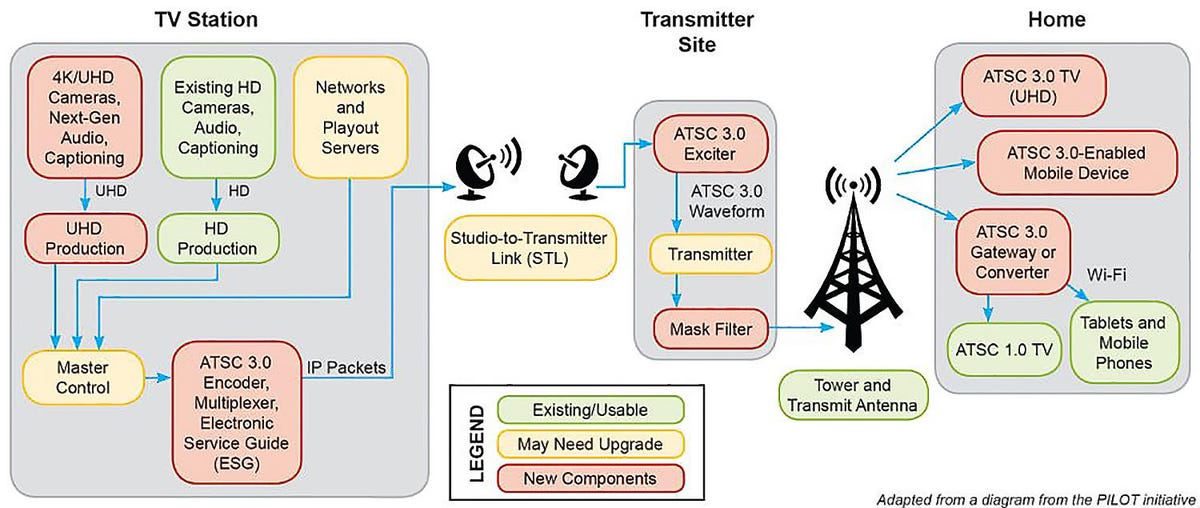
As you can see, there are lots of parts that need to get upgraded all along the chain before you can get 3.0 in your home.
ATSC/TVTechnology.comHere's another way to think about it: The first HD broadcasts began in the mid-90s, but when did you buy your first HDTV? As far as the 3.0 transition is concerned we're in the late-90s, maybe generously the early 2000s, now. Things seem like they're moving at a much more rapid pace than the transition from analog to DTV/HDTV, but even so, it will be a long time before ATSC 3.0 completely replaces the current standard.
How to get NextGen right now

If you want to check it out for yourself, many of you already can. The first stop is to go to WatchNextGenTV.com. That website will help you find what stations in your area are broadcasting, or which ones will soon.
Next up you'll need something to receive it. If you're in the market for a new TV there are several options available from Hisense, LG, Samsung, and Sony. Here's our list of all the 2022 TVs with built-in next-gen tuners.
If you want to check out NextGen TV without buying a new television, you'll need an external tuner. It's still early days, so there aren't many options.
The Tablo ATSC 3.0 Quad HDMI DVR
NuvvyoAt CES 2022 Nuvvyo announced the Tablo, a quad-tuner box that can connect to a TV directly, or transmit over a network to Rokus, Apple TVs, or computers on your home network.
The Silicon Dust has two models, the $199 HomeRun Flex 4K and the $279 HomeRun Scribe 4K. Both have ATSC 1.0 and 3.0 tuners.
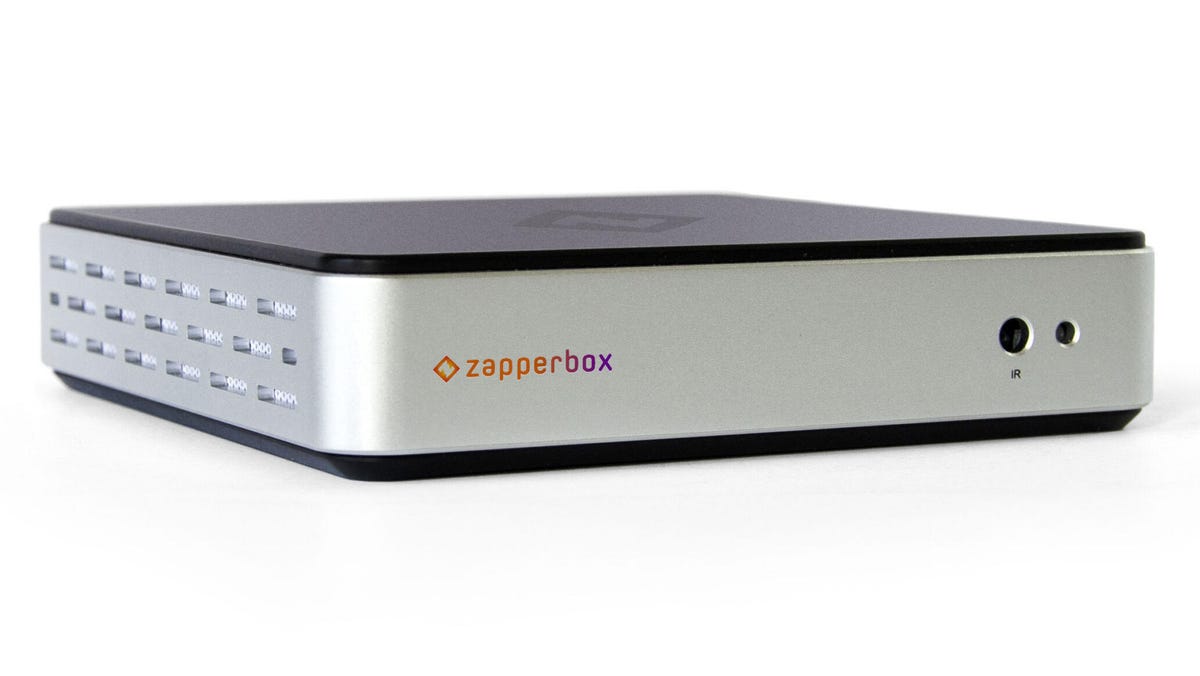
If you want a more traditional tuner, BitRouter plans to start shipping its first ZapperBox M1 tuners in the spring. You can reserve one now for $249. It doesn't have internal storage, but BitRouter plans to add the ability to save content on network-attached storage, or NAS, devices via a firmware update. They also plan to add the ability to send the content around your home network, like what the Scribe 4K does.
Then there's what to watch. Being early in the process, you're not going to find much 4K content, possibly not any. This was the same with the early years of HDTV. It's also going to vary per area. There is certainly a lot of 4K content being produced right now, and that has been the case for several years. So in that way, we're in better shape than we were in the early days of HD.
Basic and paid cable channels over-the-air?
One company is using the bandwidth and IP nature of NextGen to do something a little different. It's a hybrid paid TV service, sort of like cable/satellite, but using over-the-air broadcasts to deliver the content. It's called Evoca, and right now it's available only in Boise, Idaho. Edge Networks is the company behind it, and it wants to roll it out to other small markets where cable offerings are limited, and broadband speeds are slow or expensive.
It's an interesting idea for underserved and often forgotten-about markets.
Read more: Cable TV channels and 4K from an antenna?
Seeing the future
The transition from analog broadcasting to HD, if you count from the formation of the Grand Alliance to the final analog broadcast, took 16 years.
Though many aspects of technology move rapidly, getting dozens of companies, plus the governments of the US and many other countries, all to agree to specific standards, takes time. So does the testing of the new tech. There are a lot of cogs and sprockets that have to align for this to work, and it would be a lot harder to fix once it's all live.
But technology moves faster and faster. It's highly doubtful it will take 16 years to fully implement NextGen TV. As we mentioned at the top, dozens of stations are already broadcasting. Will every station in your city switch to NextGen TV? Probably not, but the bigger ones likely will. This is especially true if there are already other NextGen TV stations in your area. There's a potential here for stations to make additional money in the long run with 3.0, and that's obviously a big motivator.
There's also the question of how much content there will be. If it follows the HDTV transition model, big sporting events in 4K HDR will come first, followed by lots and lots of shows featuring nature scenes and closeups of bugs. Seriously -- this was totally a thing. Then we'll see a handful of scripted prime-time shows. My guess would be the popular, solidly profitable ones that are produced (not just aired) by networks like CBS and NBC.
So should you hold off buying a new TV? Nope, not unless you only get your shows over the air. And even if you do, by the time there's enough content to be interesting, there will be cheap tuner boxes you can connect to whatever TV you have.
For now, NextGen TV seems to be well on its way.
As well as covering TV and other display tech, Geoff does photo tours of cool museums and locations around the world, including nuclear submarines, massive aircraft carriers, medieval castles, epic 10,000 mile road trips, and more. Check out Tech Treks for all his tours and adventures.
He wrote a bestselling sci-fi novel about city-size submarines, along with a sequel. You can follow his adventures on Instagram and his YouTube channel.
Source

